
Audit your eSTAR cybersecurity section before the FDA does
Medcrypt audits the cybersecurity section of your eSTAR before you file. We check every item FDA asks for, from the threat model and SBOM to security testing and the 524B postmarket plan, flag what a reviewer would send back, and map each gap to the requirement it cites. Former FDA reviewers then help you close the gaps.
Regulatory & Quality
Every finding, with the requirement it maps to.
Audit like a reviewer
Medcrypt's audit scans check your quality documents against requirements and flag what a reviewer would catch, both before and after you file. See how our FDA cybersecurity submission checker works.
Every finding cites the requirement
The report reads like the one the FDA would send, with each finding mapped to the actual requirement so you know exactly what to fix.
Graded against what FDA actually enforces
Scans run on proprietary data about what the FDA is actually catching, rejecting, and requiring, so findings reflect real reviewer behavior, not just what the guidance says.
How do I prepare the cybersecurity section of my eSTAR?
The eSTAR cybersecurity section asks for a set of attachments, and reviewers check that together they tell one consistent story. Start from your threat model and work outward:
Security risk management report, with the threat model and cybersecurity risk assessment
Software bill of materials (SBOM), with support status and end-of-support dates for each component
Assessment of known vulnerabilities in those components and of unresolved anomalies
Security architecture views showing interfaces, trust boundaries and data flows
Security controls, traced to the risks they address
Cybersecurity testing reports, including penetration testing by independent testers
Cybersecurity labeling for users
Cybersecurity management plan: how you'll monitor, disclose and patch vulnerabilities after clearance, as Section 524B requires
Each document should trace to the others: every threat to a risk, every risk to a control, every control to a test. Gaps in that chain are what reviewers send back. For how eSTAR screens this section, read What is eSTAR? For the guidance behind each item, see our FDA premarket cybersecurity guidance breakdown.
Post-clearance · Section 524B
Clearance is not the finish line. Section 524B made postmarket cybersecurity a legal duty rather than a best practice, and it is one you stay accountable for every year the device is on the market. Annual reviews, new guidance, and vulnerabilities that surface long after clearance all land back on you. The same scan you ran before filing runs against your current package, so staying compliant is a re-run rather than a rebuild.
Questions about the eSTAR cybersecurity section
Yes. Medcrypt audits the cybersecurity section of your eSTAR before you file. Our audit scans check each attachment against what FDA asks for and what reviewers are actually flagging, and map every gap to the requirement it cites. Former FDA reviewers then help you prioritize and close the gaps, so you file once instead of answering a deficiency letter.
eSTAR first checks that the required cybersecurity attachments are present; a cyber device missing them can be refused before substantive review starts. In review, FDA looks at whether the threat model covers the device's interfaces, whether risks trace to controls and controls to testing, whether the SBOM is complete with known vulnerabilities assessed, whether penetration testing was independent with every finding resolved, and whether the postmarket plan explains how you'll find, disclose and patch vulnerabilities.
If required items are missing, FDA can refuse to accept the 510(k) during its acceptance review, and you have to resubmit. If the section is present but weak, you'll get an additional information request (a deficiency letter) during substantive review, and the review clock stops until you respond. Either way you lose time, so catching the gaps before you file is the cheaper fix.
Related webinar
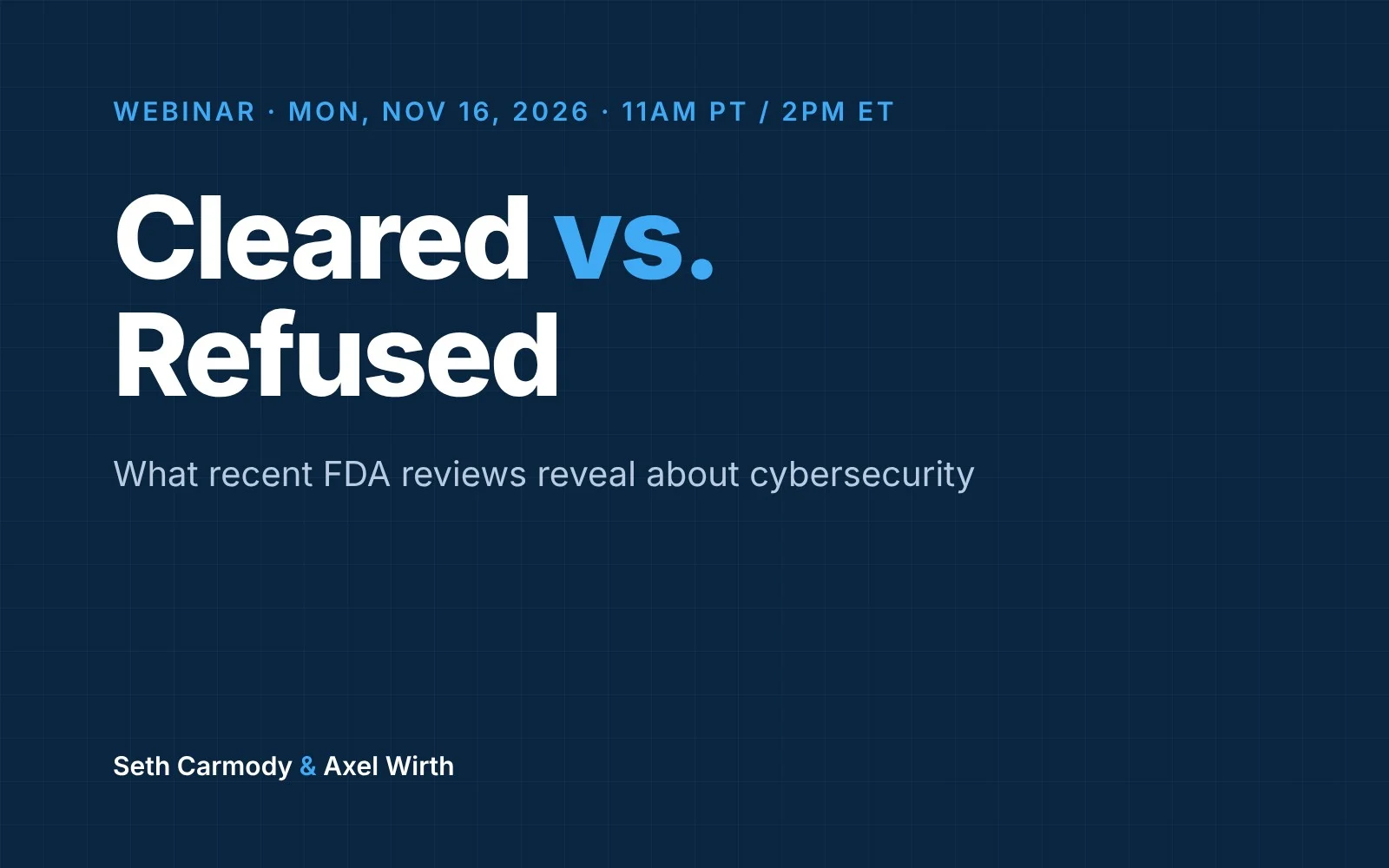
Webinar · November 16, 2026
Cleared vs. Refused: What Recent FDA Reviews Reveal About Cybersecurity
What recent FDA reviews reveal about cybersecurity evidence, CVSS, and getting devices cleared
View webinar