
Blog · November 11, 2026
FDA's new robotic surgery guidance: what it means for cybersecurity, in plain English

Mike Kijewski
The short version: In September, FDA published a draft guidance describing what surgical robot makers should show before selling in the US. The cybersecurity section is short, but it defines clear expectations. FDA expects makers to test every connection the robot has, and to show it stays safe even if the hospital network is hacked. Comments are open until November 24, 2026.
What FDA published
The draft guidance is called "Robotically-Assisted Surgical Devices: Premarket Submissions". It runs about 50 pages, and most of them cover how the robot moves, how fast it responds, and what clinical evidence FDA expects. It covers systems where the surgeon's console is in the same operating room as the patient. Cybersecurity takes up about a page and a half.
It's still a draft, so nothing in it is required yet. Drafts usually tell you where FDA reviewers are heading.
What stays the same for cybersecurity
Since 2023, federal law (Section 524B) has required makers of connected devices to map how a device could be attacked, list the software inside it, test its defenses and plan for fixing problems after launch. The robotic surgery draft confirms all of that applies to surgical robots. But it doesn't simply repeat those rules. It adds what's specific to robots on top of them.
What's new for surgical robots
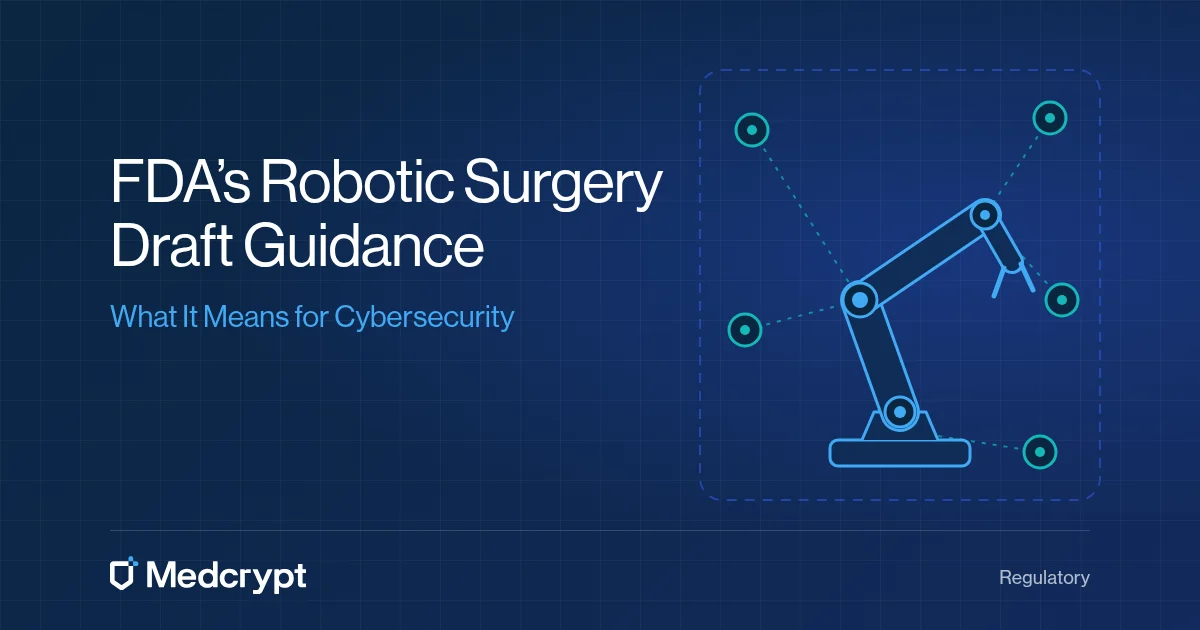
FDA wants penetration testing, a simulated attack where security experts try to break in the way a real attacker would, to cover everything in the dashed box above, not just the robot itself. It also asks makers to assume the hospital network is already compromised, which has been the agency's position on security all along. Think of planning for a burglar who's already inside the building, not just locking the front door. The robot should keep running safely, or stop safely, whatever happens on the network around it. The submission should also include a map of these connections.
What this means for your company
| Area | What changes | Ask your team |
|---|---|---|
| Testing | All connections are in scope, so plan the time and budget for testing earlier | Have we tested against the assumption of a hostile hospital network? |
| Suppliers | Third-party accessories and cloud services are in scope | Do our supplier contracts cover security testing and fixes? |
| Service | Field service tools and software updates are included | Do service tools get the same security review as the robot? |
| Safety | The robot has to fail safe when its network is attacked or drops | Can we show what the robot does when the network fails, whatever the cause? |
| Documentation | FDA wants a map of every connection | Do we have one up-to-date connection map? |
What the draft doesn't cover
The draft only addresses "local teleoperation" and explicitly excludes robots that are operated remotely (from another room or another city) and robots that act on their own. FDA asks makers of those systems to talk to the agency directly before they submit. These are also the systems where cybersecurity matters most, because the network becomes part of how the surgeon controls the robot.
How to weigh in
FDA is taking comments until November 24, 2026, on docket FDA-2026-N-9505 at regulations.gov. Two questions worth raising: how far "every connection" reaches into hospital systems a manufacturer doesn't control, and what minimum scenarios a "compromised hospital network" test should cover.
See you at White Oak
FDA will discuss remote and autonomous robots at a two-day public workshop, "Evaluating Benefit-Risk in Robotic Medical Devices with Autonomous or Remote Teleoperation Capabilities". It runs December 2-3 at FDA's White Oak campus in Silver Spring, Maryland, and by webcast.
Medcrypt CEO Mike Kijewski will attend in person. If you'll be there, or you're building a surgical robot and want to compare notes, get in touch. We'll share what we hear about cybersecurity for remote and autonomous robots after the event.
For security and regulatory teams: see how we scope penetration testing for medical devices and our work on surgical robotics cybersecurity.
Glossary
| Term | What it means |
|---|---|
| Section 524B FD&C Act | The 2023 federal law requiring connected medical devices to meet cybersecurity requirements before FDA clears them |
| Penetration testing | Hiring independent security experts to try to break into a system the way a real attacker would |
| Software bill of materials (SBOM) | A list of every software component inside a device, so known flaws can be tracked |
| Threat model | A structured map of how a device could be attacked and what protects it |
| Draft guidance | FDA's proposed approach, published for comment before it's finalized |
| Q-Submission | A formal way to get FDA feedback on a device before submitting it for clearance |
FAQ
What does FDA's robotic surgery draft guidance ask for on cybersecurity?
Section 524B compliance plus robot-specific testing: penetration testing across all connected subassemblies, accessories, back-end services and networks, and simulations of a compromised hospital network. The draft was issued September 25, 2026, and comments close November 24, 2026.
Does the draft cover remote surgery?
No. It covers local teleoperation only. FDA asks makers of remotely operated or autonomous robots to talk to the agency before they submit.
Is the draft guidance binding?
No. It's a draft published for comment, so nothing in it is required yet. Section 524B itself is law and already applies to connected surgical robots.
Sources: FDA draft guidance (Sept 25, 2026) and the FDA public workshop page.

