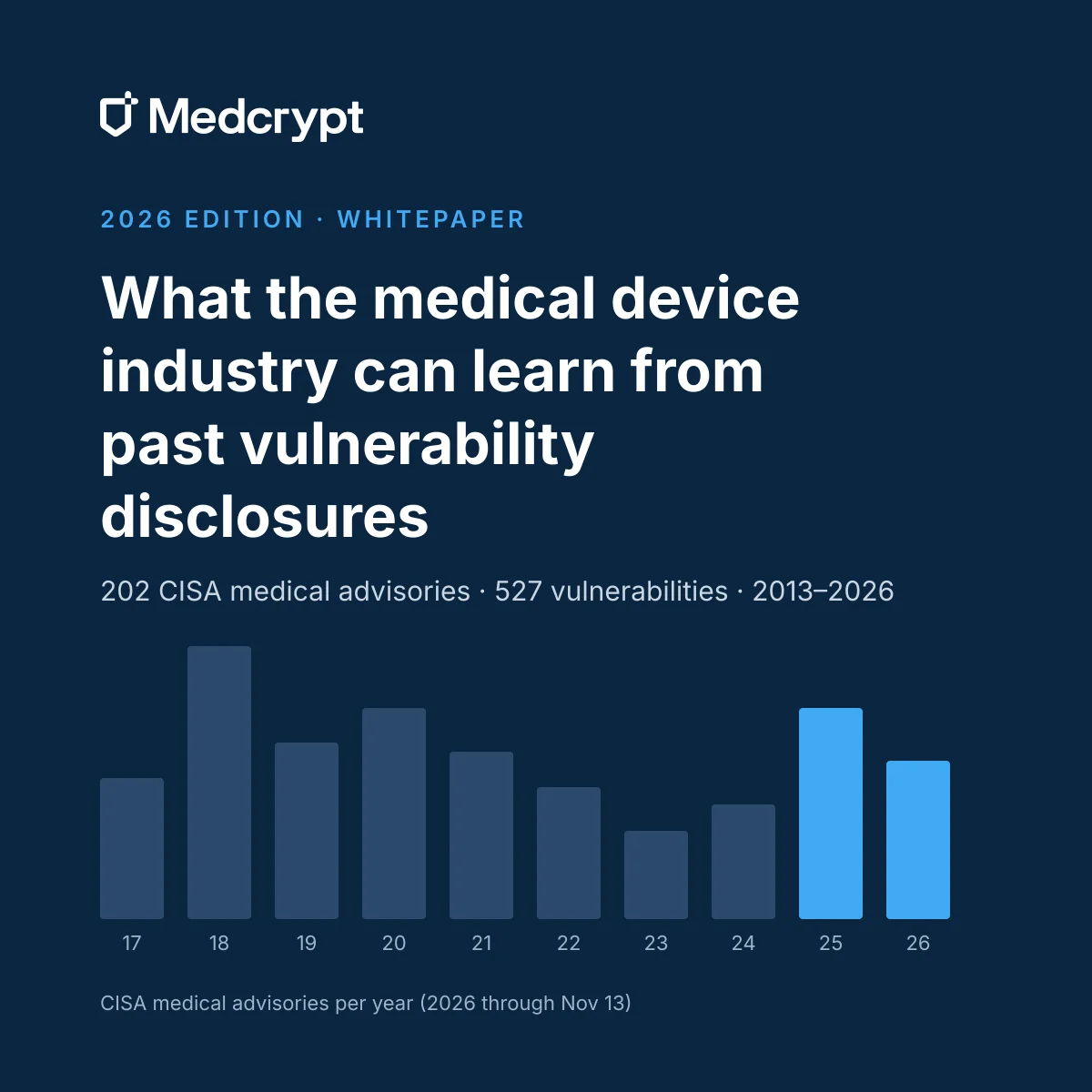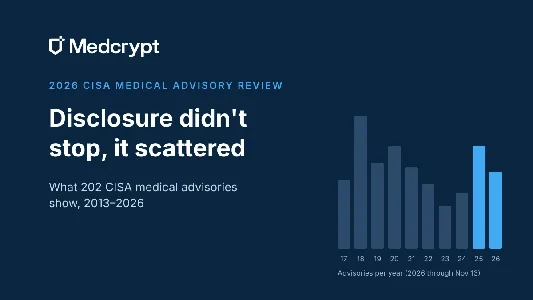
Since 2013, CISA has published 202 medical advisories covering 527 vulnerabilities. Our 2026 update of What the Medical Device Industry Can Learn from Past Cybersecurity Vulnerability Disclosures adds 42 new advisories published since our last edition, which covered through 2024. Five things stood out.
1. Disclosure moved to manufacturers' own channels
From 2017 to 2024, manufacturers reported 4 to 9 flaws a year to CISA based on their own testing. In 2025–2026, every advisory came from an outside researcher, and large manufacturers now publish on their own portals instead. That reflects maturing disclosure programs, not fewer flaws being found. But it does mean hospitals now track dozens of vendor pages instead of one feed. Adding a CISA advisory alongside your portal notice would get your notification in front of every hospital at once.
2. Imaging software took over
Imaging made up 22 of the 42 recent advisories, more than half. The DICOM standard was built for sharing, its files are complex to parse, and a handful of open-source libraries sit inside many commercial products. When one of those libraries has a flaw, it can be reported to the open-source maintainer, but there's still no defined path for the fix to reach the products built on it.
3. Severity is rising, and fixes are harder to ship
The median highest CVSS v3 score per advisory rose from 7.1 (2017–2020) to 7.8 (2025–2026). The share of advisories with a patch available fell from 83% in 2025 to 67% in 2026. Some of those advisories covered products already past their end of support. In four others, CISA couldn't reach the vendor or maintainer, two of which were volunteer-run open-source projects.
4. Enterprise attacks reach product security, even without a device flaw
None of 2026's major attacks on manufacturers started with a device vulnerability, and the companies said their products weren't affected. Yet the attacks still cost revenue and production time. The systems that build, sign and update devices often sit inside that same enterprise. Being able to demonstrate separation is becoming part of the product security story.
5. AI is changing who finds flaws, and what counts as a component
A few researchers now cover huge amounts of open-source code, maintainers are falling behind, and no medical advisory yet covers the risks in AI models and model files.
What to do about it
Manufacturers can pair portal notices with a CISA advisory and track open-source libraries and AI models in their SBOMs. Hospitals shouldn't rely on CISA alone for vulnerability notifications.
Read the full 2026 whitepaper →