
Blog · April 11, 2024
Are all SBOM tools created equal?

Om Mahida
Updated November 2026.
The short version: An SBOM tool for medical devices should find the known vulnerabilities in your software, rank them by real risk and cut the false alarms, so your team spends its time on the threats that matter. Helm is built only for medical device makers: it automates CVSS v3 rescoring, supports FDA cybersecurity guidance and NTIA minimum requirements, and generates FDA-ready reports.
Why precision matters in an SBOM tool
In the realm of post-market vigilance and product security, precision in vulnerability detection is not just desirable, it’s essential. For a Medical Device Manufacturer (MDM) product security expert, choosing the right tools can make all the difference in identifying and mitigating risks effectively. While open-source options might initially seem appealing, there are compelling reasons to opt for tools that offer added value.
What to look for in a SBOM and vulnerability management tool?
When assessing SBOM and vulnerability management tools, it’s imperative to grasp the essential features tailored specifically for the needs of medical device manufacturers. A dependable SBOM and vulnerability management tool should provide:
- Regulatory Compliance: Ensure alignment with relevant regulatory standards such as HIPAA, GDPR, or PCI DSS, and look for features facilitating compliance reporting and auditing.
- Comprehensive Vulnerability Detection: Look for a tool proficient at identifying known vulnerabilities and providing thorough analysis to uncover potential risks across your software ecosystem.
- Integration Capabilities: Ensure seamless integration with existing systems like development environments, CI/CD pipelines, or PLM systems to enhance collaboration across teams.
- Automation for Efficient Workflows: Leverage automation features for tasks such as vulnerability scanning, prioritization, and reporting to reduce manual errors and accelerate response times to security threats.
- Scalability and Flexibility: Opt for a tool that is scalable and flexible enough to adapt to your organization’s growth and evolving security requirements, regardless of size.
- Actionable Insights: Prioritize tools offering actionable insights such as risk scoring, threat intelligence integration, and remediation guidance to empower informed decision-making and efficient threat mitigation.
- User-Friendly Interface: Choose a tool with an intuitive dashboard, customizable views, and easy navigation to maximize user adoption and productivity.
By evaluating these features, organizations can select an SBOM and vulnerability management tool that meets their specific needs, thereby enhancing post-market vigilance and product security effectively.
What is Helm?
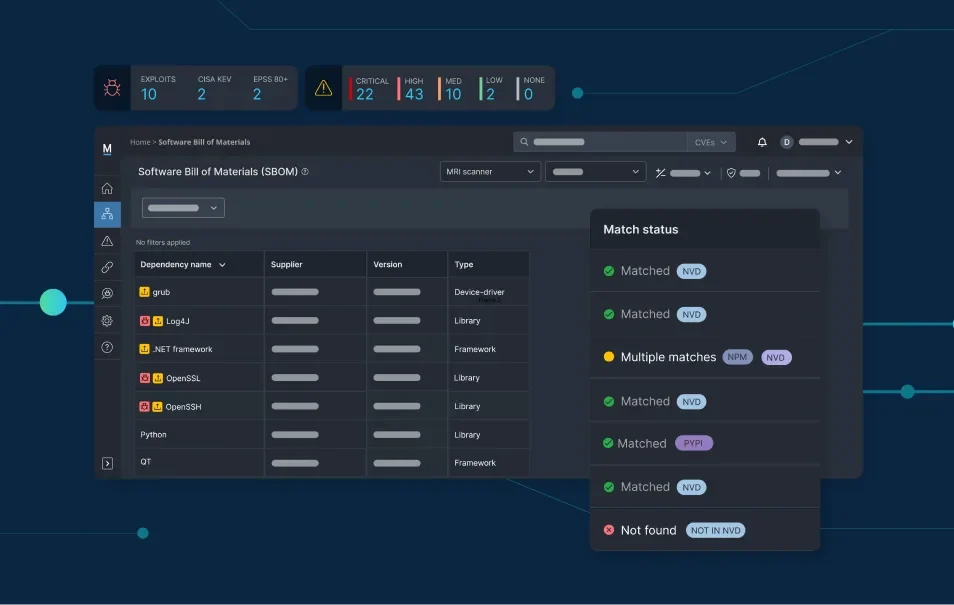
Medcrypt Helm
Helm stands out as a continuous software bill of materials (SBOM) and vulnerability solution tailored specifically for medical device manufacturers (MDMs), unlike generic tools designed for multiple industries, Medcrypt and Helm are laser-focused on the needs of medical device manufacturers (MDMs). It provides full visibility across the entire medical device operating systems, firmware, and software supply chain, enabling detection, prioritization, and remediation of cybersecurity risks.
Helm offers continuous integration, analysis, and transparency of the evolving state of the medical device software supply chain to proactively identify and mitigate exploitable vulnerabilities. It provides up-to-date information on changes to vulnerabilities, including new exploits and threats, along with recommended fixes.
Helm provides a comprehensive view of risk across all product lines, ensuring compliance with FDA cybersecurity guidelines and NTIA minimum requirements, while also facilitating the generation of FDA-ready reports and enabling faster triaging and assessment of vulnerabilities compared to other tools.
Enhancing Software Security with Helm:
Comparing Helm with other SBOM and vulnerability management tools is essential for selecting the right solution. Here are the strengths of Helm:
-
Streamlined Compliance: Helm simplifies adherence to regulatory standards, providing features and reports to support compliance reporting and auditing, thereby enhancing post-market vigilance and product security.
-
Effortless Rescoring: Helm automates CVSS v3 vulnerability rescoring, reducing manual burden and preventing missing or incorrect rescoring, thus saving time and resources.
-
Superior Accuracy in Vulnerability Detection and False Positives: Helm demonstrates remarkable precision in vulnerability detection, prioritization, and addressing real threats effectively. It significantly reduces false alarms, allowing security teams to focus on the most critical vulnerabilities.
-
Seamless Integration and Workflow Automation: Helm seamlessly integrates with existing systems, streamlining vulnerability management processes through a customer-facing API.
-
Actionable Insights for Risk Mitigation: Helm provides actionable insights, empowering teams to prioritize and mitigate vulnerabilities effectively.
Choosing an SBOM tool built for medical devices
In summary, the importance of selecting the appropriate SBOM tool cannot be overstated, particularly when it concerns the security and compliance of medical devices. Helm stands out as a tool specifically designed to meet the distinct requirements of medical device manufacturers. Its comprehensive features, focused on streamlined compliance and providing actionable insights, make it a valuable resource for enhancing post-market vigilance and product security. Utilizing Helm enables organizations to proactively address cybersecurity risks, safeguarding both their products and their reputation in the process.
FAQ
What should an SBOM tool for medical devices do?
Find the known vulnerabilities across your device's operating systems, firmware and software supply chain, then rank them so your team acts on the ones that matter. Look for accurate detection with few false alarms, risk scoring and remediation guidance, automated CVSS rescoring, integration with your CI/CD pipelines and PLM systems, and reports that support FDA cybersecurity guidance and NTIA minimum requirements.
Why do generic and open-source SBOM tools raise so many false alarms?
Most tools match components loosely, and one bad match cascades into a queue of irrelevant alerts. Generic tools are also built for many industries rather than for medical devices. Helm matches every component against known software in the NVD, with alias rules for the ambiguous ones, so the queue stays worth reading.
How does VEX cut the noise?
A VEX (Vulnerability Exploitability eXchange) statement records whether a known vulnerability actually affects your device, with a justification such as 'component not present' or 'vulnerable code not reachable'. It lets you show FDA you've assessed every CVE match without patching ones that can't be exploited. Helm exports VEX and VDR reports alongside the FDA-ready SBOM.
Interested in learning more about how Medcrypt helps medical device manufacturers meet regulatory requirements? Contact us at info@medcrypt.com and visit us at medcrypt.com to discover our full suite of medical device cybersecurity products and services.


