

In May 2026, Google's Threat Intelligence Group disclosed something researchers had been expecting but hadn't yet confirmed in the wild: a group of financially motivated hackers used an AI model to discover and weaponize a previously unknown vulnerability, or "zero-day," in a popular open-source administration platform. The flaw let attackers bypass two-factor authentication by exploiting a hidden trust assumption in the software's authentication logic, the kind of subtle error that typically takes a skilled human researcher considerable time to find. Google worked with the software's vendor, which it didn't name, to patch the flaw before, it says, the campaign could be used at scale.
That kind of capability used to come at a price. Zero-days have historically been scarce (Google's own tracking puts the number exploited at roughly 60 to 100 a year) and expensive, often trading from the low six figures into the millions depending on the target. If AI takes over more of the discovery work that used to require scarce, specialized researchers, it's worth asking whether that scarcity, and the price it commands, holds up. Google's report also described a North Korean group using AI to test thousands of exploit attempts, and malware that reads an infected device's screen and generates its own commands in real time. The specific examples matter less than the underlying shift: hackers finding new vulnerabilities with more ease, and at greater scale, than before.
Less-targeted industries have long relied on simple economics for protection. Finding a novel flaw in unfamiliar software takes time and specialized expertise, and that expertise has traditionally paid off best against widely distributed software, the operating systems, cloud platforms, and enterprise tools used by thousands of organizations, where one exploit reaches many targets at once. Niche or uncommon systems haven't drawn the same investment, not because they're harder to breach, but because the payoff didn't justify the effort. Google's report suggests that math may be shifting: an AI model read through unfamiliar code, identified a logic flaw, and helped produce a working exploit, work that would typically take a specialized researcher far longer, and there's nothing about that process specific to the system Google observed.
Medical device software fits that lower-payoff profile closely: specialized, sometimes decades-old codebases and proprietary protocols that look nothing like a typical enterprise IT environment, exactly the kind of system that hasn't drawn much attacker investment, not because it's more secure, but because it hasn't been worth the effort. Whether that holds up as AI tools keep improving is worth watching. This isn't a forecast of a specific incident; it's a reason to make sure current defenses don't depend on an assumption that's quietly eroding.
That question isn't entirely hypothetical already. In June 2026, Novo Nordisk disclosed that attackers had unauthorized access inside its systems for roughly two months before detection, reportedly starting from a single compromised credential, with clinical trial records, source code, and the company's own internal AI models among the data involved. In a widely shared LinkedIn post on the disclosure, Oleksandr Bondar raised the harder question: it's not only about what data was demonstrably accessed, it's proving what data was not changed while access sat undetected for months, since regulated decisions rest on records that have to be attributable, contemporaneous, and verifiable. It's a different angle on the same shift: AI-accelerated discovery is about attackers getting in faster, and cases like this are a reminder that once they're in, proving what happened afterward depends on evidence that already has to be in place before anyone knows to look.

When a new attacker technique makes headlines, the natural response is to ask, "Are we exposed to that specific threat?" Check the affected component, confirm it's not in your product, move on. That instinct isn't wrong, but it treats each discovery as an isolated problem to resolve on its own terms, and it becomes harder to sustain as the pace and volume of AI-assisted discovery increases. What holds up is systemic capacity: the underlying ability to see, assess, and respond to new risk across the entire product line, wherever it appears, rather than a one-off fix built for the last headline.
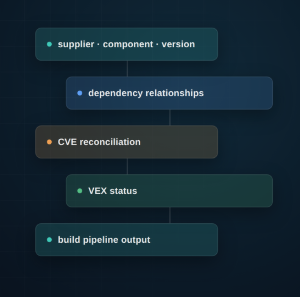
In practice, that means an accurate, current Software Bill of Materials (SBOM) so "are we affected?" can be answered in hours instead of weeks; secure development and threat modeling built into the Total Product Lifecycle rather than bolted on at release; standing, continuous vulnerability management instead of periodic review; tamper-evident, cryptographically verifiable records so data integrity and non-repudiation can be demonstrated rather than assumed if access is ever in question; and a documented, tested incident response plan rehearsed before it's needed.
None of these are new ideas, and none are specific to AI-assisted attacks. That's the point. Whatever role AI ends up playing in future threats to healthcare, manufacturers who've already built systemic defenses will be in a stronger position than those relying on a fix tailored to any one story.
At Medcrypt, this is the work we do every day with medical device manufacturers, from SBOM and vulnerability management to secure development lifecycle support and FDA cybersecurity readiness. If you want to talk through how your organization's defenses hold up against this kind of shift, let's talk.
Sources: Google Threat Intelligence Group, "Adversaries Leverage AI for Vulnerability Exploitation, Augmented Operations, and Initial Access," May 2026, as reported by The New York Times and other outlets; Novo Nordisk incident disclosure and Reuters reporting, June 2026.

August 19, 2026

August 3, 2026

July 29, 2026
Get the latest healthcare cybersecurity news right in your inbox.
We'll never spam you or sell your information

