SBOM — From Regulatory Checkbox to Cybersecurity Backbone
How Software Bill of Materials Outgrew Medical Devices
For most of its existence, the Software Bill of Materials lived a quiet life in regulated corners of the economy. Medical device manufacturers got comfortable with it because the FDA required it. Other industries treated it as somebody else's problem.
That's no longer true. SBOM is becoming a baseline expectation across automotive, industrial control systems, consumer IoT, and general enterprise software — driven by new regulation, most notably the EU's Cyber Resilience Act, and by customers who now ask for one before they sign a contract. Here's how we got here, what's changed recently, and what it means for manufacturers and the people who buy their products.
A Brief History of SBOM
The idea of tracking software components the way manufacturers track physical parts predates any regulation. SPDX (2010) started as a way to document open-source licenses and copyright obligations, and became an ISO standard in 2021 — but its roots are in legal compliance, not security. CycloneDX (2017) took a different angle: OWASP built it specifically for application security, a lightweight, machine-readable inventory that vulnerability scanners could match against CVE feeds. That security-first framing turned out to be prescient.
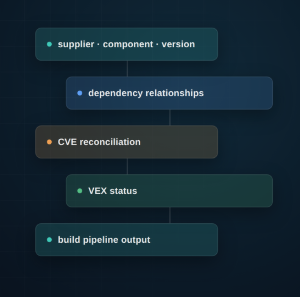
The real inflection point came in 2020–2021. The SolarWinds breach exposed how blind most organizations were to their own software supply chain, a realization that a few months later led to Executive Order 14028 on cybersecurity. That order directed NTIA to define a baseline SBOM standard — the "Minimum Elements" (supplier, component name, version, dependency relationships), published in July 2021.
Medical devices got there early because Congress gave the FDA explicit authority: Section 524B of the FD&C Act (2023) made a machine-readable SBOM a premarket submission requirement for any "cyber device." CISA has since picked up where NTIA left off, publishing updated 2026 Minimum Elements guidance to reflect how much SBOM tooling and practice have matured.
What's Changed Recently
Three developments explain why SBOM is suddenly everyone's problem:
EU Cyber Resilience Act
Covers nearly any connected product sold in the EU. Machine-readable SBOM required under Article 13 & Annex I. Incident reporting (24-hr/72-hr) starts Sept 11, 2026; full CE-marking by Dec 11, 2027.
FDA's Evolving Guidance
Feb 2026 revision keeps SBOM, threat modeling, and secure-lifecycle expectations intact — and expands SBOM scope to end-of-support metadata and VEX documents, required starting March 2026.
Other Industries Followed
Auto-ISAC published its own SBOM guidance in 2025. IoT and consumer electronics face similar pressure from labeling schemes, procurement questionnaires, and buyer expectations — with or without a legal mandate.
The Clock Is Ticking
The EU CRA's 24-hour/72-hour incident-reporting clock starts Sept 11, 2026.
Full conformity assessment & CE-marking: Dec 11, 2027 · Penalties: up to €15M or 2.5% of global turnover
Because accurate SBOM data is a prerequisite for meeting that 24-hour reporting clock, organizations need SBOM programs operating well before the 2027 deadline — not after. Increasingly, SBOM requests are also showing up in vendor security questionnaires and RFPs well outside any legal mandate.
What This Means for Manufacturers and Consumers
For manufacturers, the shift is from SBOM as a one-time regulatory submission artifact to SBOM as a living, operational security tool. An SBOM is only useful if it's continuously reconciled against vulnerability feeds — which means integrating SBOM generation into the build pipeline rather than assembling one by hand before a filing deadline.
Paired with VEX, this lets a manufacturer answer the question customers and regulators actually care about — not "what's in this product," but "is this product currently exposed to a given exploit."
Strategically, SBOM is now dual-purpose: compliance infrastructure for FDA (and soon CRA) obligations, and a market differentiator. Customers doing security due diligence — hospital systems, enterprise IT buyers, automotive OEMs vetting Tier 1 suppliers — increasingly ask for an SBOM as a baseline for security competence, the way they'd ask for a SOC 2 report. Manufacturers that can produce an SBOM on demand, with current VEX status, close deals faster. Manufacturers that can't will be falling behind those that can.
For consumers and enterprise buyers, the shift is from taking a vendor's security claims on faith to being able to ask directly: what's actually in this product, and is it currently vulnerable to anything known. Most people won't read a raw SBOM file — but the information now exists for security teams, researchers, and regulators to check claims and enforce security maturity in the buying process.
Steps to Align with New Requirements
Make SBOMs a build output
Generate SPDX or CycloneDX SBOMs automatically with every build — not as a manual pre-submission exercise. It's the only way to meet the CRA's 24-hour reporting clock.
Monitor continuously
Maintain SBOMs after market release: stand up automated reconciliation against CVE feeds, and start producing VEX documents so customers know which findings actually apply to them.
Assign clear ownership
Name who's accountable for SBOM accuracy across the product lifecycle — including after end-of-support, since regulators now expect that metadata too.
Unify overlapping regimes
Treat FDA, EU CRA, and customer procurement asks as one program on a common, well-documented data set — not separate compliance exercises.
Get ahead of the market
Even manufacturers outside SBOM's current legal scope should expect it in the next RFP. A good answer is a competitive advantage, not just a defensive one.
Conclusion: SBOM Is a Security Practice, Not a Paperwork Exercise
It's easy to read all of this as a story about regulation, because regulation is what's forcing the timeline. But SBOM works as a regulatory requirement because it's first and foremost a vulnerability management tool. It turns "what's running in our product" from a question someone researches by hand after a new CVE breaks, into something a system answers in seconds. Reconciled continuously against vulnerability feeds and paired with VEX data, it lets manufacturers find and respond to real exposure faster, patch with more precision, and keep a product's security posture current for as long as it's in the field — not just at the moment of certification. Compliance is a byproduct of doing that well, not the goal itself.
Bottom Line
SBOM's two lineages — SPDX out of license compliance, CycloneDX out of application security — converged into one expectation once SolarWinds and EO 14028 made software supply chain risk impossible to ignore. Medical devices got there early because the FDA had explicit statutory authority; the EU CRA changes the scope entirely, applying to nearly any connected product sold in the EU on a timeline that starts biting in September 2026. Automotive and consumer IoT are following, driven as much by customer expectations as by law. And increasingly, international regulators are aligning by stipulating their respective SBOM requirements (see appendix).
The manufacturers in the best position aren't assembling an SBOM to satisfy a filing — they've made it a routine build output tied to ongoing vulnerability monitoring, so security posture stays current automatically.
Appendix: Global SBOM Regulations and Frameworks at a Glance
This list reflects the landscape as of mid-2026 and is moving quickly — treat it as a starting point for tracking obligations relevant to your specific markets and product categories, not a substitute for legal review.
| Region / Country | Regulation or Scheme | Status | What It Covers |
|---|---|---|---|
| United States | Executive Order 14028 + NTIA Minimum Elements (2021, updated by CISA in 2025) | Mandatory | SBOM required for software sold to the federal government |
| United States | FDA Guidance / Section 524B (FD&C Act) | Mandatory | Machine-readable SBOM required in premarket submissions for "cyber devices" (medical devices) |
| United States | NIST SP 800-218 (SSDF) | Referenced / risk-based | Underpins federal secure-development and attestation expectations; OMB's Jan 2026 memo (M-26-05) moved this to an agency-led, risk-based approach rather than blanket mandatory attestation |
| United States | PCI DSS v4.0 | De facto requirement | "Evolving Requirements" for software component inventories (effective March 2025), commonly met with an SBOM |
| European Union | Cyber Resilience Act (CRA) | Mandatory | Machine-readable SBOM (Article 13, Annex I) for nearly all products with digital elements; vulnerability/incident reporting starts Sept 11, 2026, full conformity assessment by Dec 11, 2027 |
| European Union | Medical Device Regulation (MDR) and In Vitro Diagnostic Regulation (IVDR) | De facto requirement | Requires a "List of SOUP components" and mandates vulnerability monitoring, post-market surveillance, and security risk management "in accordance with the state of the art," by reference to IEC 62304 and IEC 81001-5-1 |
| United Kingdom | Product Security and Telecommunications Infrastructure (PSTI) Act | Indirect | Doesn't mandate SBOM directly, but as of Dec 2025/Jan 2026 recognizes Japan's JC-STAR and Singapore's CLS labels, which do involve component declarations |
| Japan | JC-STAR IoT labeling scheme (METI/IPA) | Labeling scheme | Component declaration requirements at higher conformance levels (STAR-1 through STAR-4) |
| Singapore | Cybersecurity Labelling Scheme (CLS) for IoT | Labeling scheme | Requires vendors to account for known vulnerabilities in declared software components — a de facto SBOM requirement |
| South Korea | Government SBOM mandate (KISA-led) | Mandatory (phasing in) | SBOMs required for public-sector IT systems and products; full institutionalization targeted for 2027 |
| China | GB 44495-2024 | Mandatory | Vehicle cybersecurity standard in force since Jan 1, 2026; includes software supply-chain visibility |
| Global (automotive) | UNECE R155 / R156 | Mandatory (EU/UNECE) | Cybersecurity Management System and Software Update Management System covering supply-chain risk; doesn't name SBOM explicitly but component visibility is the practical way to comply |
| Global (automotive) | Auto-ISAC SBOM informational report (2025) | Voluntary guidance | Industry-specific SBOM practices for automotive suppliers and OEMs |
| India, Australia | Various critical-infrastructure and supply-chain guidance | Emerging | Referenced in industry commentary as embedding SBOM expectations, but no confirmed standalone binding SBOM mandate as of this writing |