CISA SBOM Minimum Elements: 2026 Update
Sources: 2026 CISA Minimum Elements for SBOM · 2021 NTIA Minimum Elements
CISA has released an updated "Minimum Elements for a Software Bill of Materials (SBOM)," replacing the 2021 NTIA baseline. Below is what changed and why it matters for software producers, SBOM consumers, and regulators.
The Big Picture
SBOM guidance is no longer a US-only effort. The 2026 update is co-authored by cybersecurity agencies across the US, Australia, Canada, Czech Republic, France, Germany, India, Italy, Japan, Korea, Netherlands, New Zealand, Poland, and Slovakia.
For medical device makers specifically: FDA cybersecurity guidance had treated Component Hash as mandatory (via the NTIA Framing Document), even though NTIA's own Minimum Elements listed it as merely "recommended." The 2026 update resolves that disconnect — Component Hash is now mandatory across the board.
Further, the 2026 CISA Minimum Elements for SBOM document updates the foundational 2021 NTIA guidance by adding new data fields, updating terminology for clarity, adding focus on SBOM operational aspects, and expanding scope to modern software like AI and SaaS.
New & Elevated Data Fields
| Field | Why it matters |
|---|---|
| Component Hash (Value & Algorithm) | Cryptographic fingerprint that verifies component integrity — now mandatory, closing the FDA/NTIA gap where it was previously only "recommended." |
| Component License | Promoted from optional to a core field to track usage rights and legal obligations. |
| SBOM Tool Name & Provenance | Identifies the specific tool that generated the SBOM. |
| SBOM Generation Context | Captures the lifecycle stage (e.g., pre-build vs. post-build) when the SBOM was created. |
Terminology Changes
| 2021 NTIA Term | 2026 CISA Term |
|---|---|
| Supplier | Software Producer |
| Author of SBOM Data | SBOM Author |
| Version of the Component | Component Version |
| Depth | Coverage — now explicitly includes configuration files and deployment instances |
| Access Control | Folded into Distribution and Delivery |
Broader Scope, Less Tolerance for Gaps
The broadened scope now explicitly covers open-source, AI software, and SaaS — not just traditional packaged software. Error handling also gets stricter: instead of tolerating incidental mistakes, authors are expected to issue prompt corrections, and any missing data must be explicitly labeled as unknown, redacted, or not applicable rather than silently omitted.
Built for Automation, Not Just Compliance
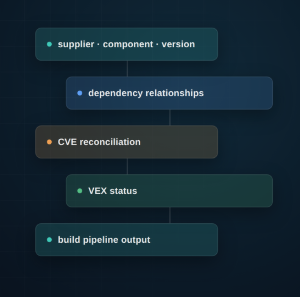
The 2026 guidance pushes SBOMs from static compliance paperwork toward machine-readable operational records that organizations continuously cross-reference against CVE/VEX vulnerability feeds. Standardized fields (component hash, tool name, generation context) let automated tooling verify integrity and gauge data fidelity without manual review. It also pushes harder on capturing full transitive-dependency trees, so tools can recursively surface vulnerabilities buried deep in a dependency chain — and it favors structured, machine-parsable formats like SPDX and CycloneDX over legacy formats such as SWID tags.
Bottom Line
SBOM now sits on an internationally aligned foundation and explicitly supports cybersecurity, end-of-life management, license management, and export control use cases. It also starts addressing SBOM operations across the full lifecycle and participating stakeholders — procurement, vulnerability management, end-of-life — rather than a static, compliance-driven mindset of the 2021 NTIA version. How US regulators like the FDA, and their international counterparts, put this improved baseline to use will be worth watching.